
Desert Marigold
Baileya multiradiata

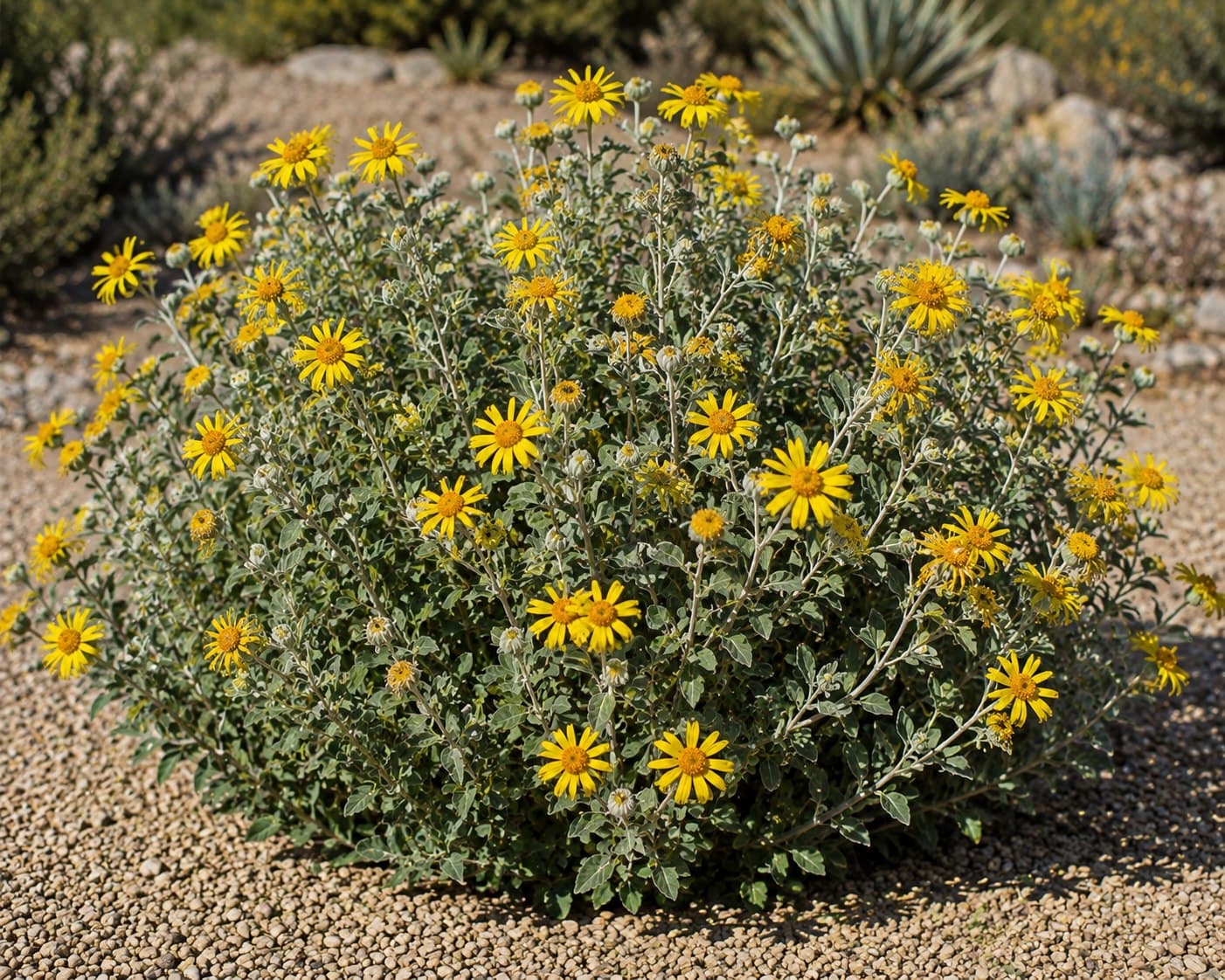
A cheerful Southwestern native that blankets the landscape with sunny yellow daisies nearly every month of the year.
Hardy in USDA zones 9-11; evergreen and everblooming in the low desert, briefly cold-deciduous only during hard frosts, and thrives in both low- and mid-desert elevations.
AMWUA Notes
A true desert survivor that blooms on rainfall alone once established; ideal for unirrigated wildflower zones.
Care Guide
Water established plants deeply every 2-3 weeks in summer and monthly in winter; overwatering shortens its life, so let soil dry between drinks.
Shear spent flower stalks back by half after each heavy bloom flush to keep the mound tidy and encourage rebloom; leave some seed heads for birds and reseeding.
No fertilizer needed — rich soil produces leggy, floppy growth; it performs best in lean, gritty desert soil.
Largely pest-free; aphids may cluster on new flower stalks but are easily rinsed off with a hose.
A short-lived perennial that reseeds prolifically; leave the last flush of seed heads in fall to guarantee next season's volunteers.
Soil, Feeding & Propagation
Lean, gritty, sandy or decomposed-granite desert soils; tolerates rocky, alkaline, and caliche ground and rejects rich or amended soil.
Needs sharp, fast-draining soil.
None — thrives in lean desert soil without fertilizer.
Seed only; direct-sow in fall or spring and it reseeds prolifically. Its taproot resents transplanting and it does not divide or root from cuttings.
1 ft
Deep taproot makes established plants hard to move; short-lived but reseeds freely, so let volunteers replace aging crowns.
Placement Tips
- •Mass in drifts of 5-7 for a naturalistic sea of yellow rather than dotting single plants.
- •Site along walkways and front-of-border spots where its year-round color reads from a distance.
- •Let it reseed freely into gravel mulch; thin volunteers to keep spacing at about 12 inches.
- •Thrives in reflected heat against west-facing walls and along hot driveway edges.
Features
Best Uses
Ecological Value
Attracts
Wildlife Value
Companion Plants



Quick Stats
Design Styles
Include in Your Project
Love Desert Marigold? Our landscape team sources from wholesale nurseries and can incorporate it into your design.
Talk to a Dream BuilderGet a Project EstimateAlready a Client?
Use this care guide to maintain your Desert Marigold. Questions about your landscape? Reach out anytime.
Data from 2024 AMWUA “Landscape Plants for the Arizona Desert” guide.
Desert Marigold — common questions
Answers for low-desert Phoenix conditions, drawn from this plant’s growing data.
How much water does Desert Marigold need in Phoenix?
Desert Marigold is a very low-water perennial once established. Water established plants deeply every 2-3 weeks in summer and monthly in winter; overwatering shortens its life, so let soil dry between drinks. A true desert survivor that blooms on rainfall alone once established; ideal for unirrigated wildflower zones.
How big does Desert Marigold get?
Expect roughly 1 ft tall and 1 ft wide at maturity, with a moderate growth rate. Allow about 1 ft of spacing when planting. Deep taproot makes established plants hard to move; short-lived but reseeds freely, so let volunteers replace aging crowns.
Can you plant Desert Marigold near a pool?
Yes. Desert Marigold is considered pool-friendly, meaning it stays clean enough around water features and hardscape. Litter is rated low.
Can Desert Marigold handle Arizona heat and winter frost?
Desert Marigold is hardy in USDA 9-11 and wants full sun. Hardy in USDA zones 9-11; evergreen and everblooming in the low desert, briefly cold-deciduous only during hard frosts, and thrives in both low- and mid-desert elevations. A short-lived perennial that reseeds prolifically; leave the last flush of seed heads in fall to guarantee next season's volunteers.
Does Desert Marigold have thorns?
No. Desert Marigold is thornless, so it is safe alongside walkways, patios and play areas.
Is Desert Marigold safe around pets?
Desert Marigold is listed as pet-friendly in this guide. If your dog is a determined chewer, check any new plant with your vet before planting.
When does Desert Marigold bloom in Arizona?
Desert Marigold blooms in year-round, with yellow flowers. The bloom draws bees.
How much maintenance does Desert Marigold need?
Desert Marigold is low-maintenance. Leaf, flower and pod litter is rated low. Shear spent flower stalks back by half after each heavy bloom flush to keep the mound tidy and encourage rebloom; leave some seed heads for birds and reseeding.
What kind of soil does Desert Marigold need?
Lean, gritty, sandy or decomposed-granite desert soils; tolerates rocky, alkaline, and caliche ground and rejects rich or amended soil. It needs no supplemental feeding. No fertilizer needed — rich soil produces leggy, floppy growth; it performs best in lean, gritty desert soil.
Is Desert Marigold native to Arizona?
Yes. Desert Marigold is native to Arizona and to the Southwestern US, Northern Mexico, so it is adapted to local rainfall, soil and heat.